
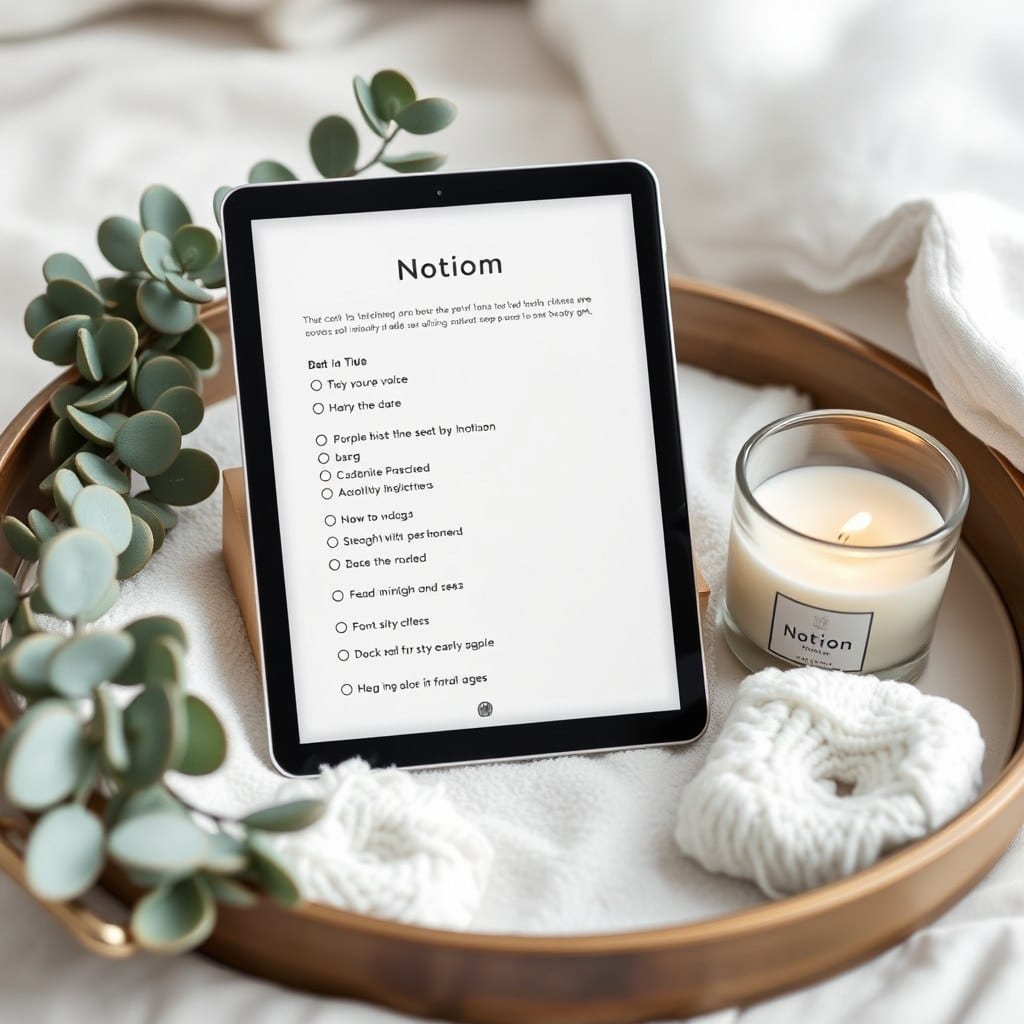
There’s a genre of Notion content that treats the app like a sport. Dashboards with twelve linked databases, automated rollups, a habit tracker that pings you three times before noon. It looks impressive in a screenshot. It falls apart by Thursday.
I’ve watched dozens of people build those setups and abandon them, and the pattern is always the same: the system asks more of them than the life it was supposed to hold.
A slower setup starts from a different question. Not “what could I track?” but “what do I actually want to look at on a Tuesday morning?” That reframing changes almost everything about how you build.
**Start with one page.** Not a dashboard. One page you’d open because it’s pleasant. For most of the people I build for, that’s a journal page: a date, a few prompts, a place to put the day down. It has no metrics. Nothing turns red. The only job is to exist and be easy to return to.
When that page has survived two weeks, add a second. Maybe a goals page with three slots, not thirty. The constraint is the point. Three goals you can hold in your head will get more attention than a database of forty you never reopen.
**Resist the urge to automate the parts that feel good.** There’s a reason paper planners still sell. The act of writing the date, of choosing where something goes, is part of how you think. If you automate your weekly review into a recurring template that fills itself in, you’ve removed the reflection and kept the chore. Some friction is the work.
I learned this the hard way with a client who wanted her entire meal planning, budgeting, and reading log to flow into a single weekly dashboard. We built it. It was beautiful. She used it for eleven days. When we talked about why, she said the dashboard answered questions she hadn’t asked. She wanted to decide what to cook on Sunday, not see a bar chart of her protein intake. We cut it to a single page with a running list and a note for the week. She’s still using it.
**Small systems compound because they survive.** A journal you open for ninety seconds every night beats a journal you open for twenty minutes once and then avoid because it feels like homework. The math favors the version you’ll return to, not the version that impresses.
There’s a social pressure here too. Notion screenshots reward density. A sparse page with a heading and three lines doesn’t get shared as often as a wall of linked views. But you’re not building for the screenshot. You’re building for the version of yourself who opens the app after a long day and needs somewhere gentle to land.
**What slow actually looks like.** It means fewer databases, more plain pages. It means choosing a color palette you like and using it everywhere, so the space feels like one room instead of a maze of rooms. It means writing your own headings instead of accepting the default ones, because the words set the tone for how you use the page.
It also means auditing. Once a season, open your setup and ask what you haven’t touched. Delete it without guilt. A template you don’t use isn’t neutral; it’s a small reproach every time you scroll past it. Slowness includes subtraction.
None of this is anti-tool. Notion is remarkable precisely because it can be shaped into something that feels like yours. The point is to shape it toward calm rather than capability. Capability is infinite and will always outrun you. Calm is finite, and you can build it on purpose.
If you’ve tried the dense dashboards and quietly quit them, you’re not bad at systems. You were building at the wrong speed. Start smaller than feels reasonable. Keep the pages you’d want to open. Let the rest go.